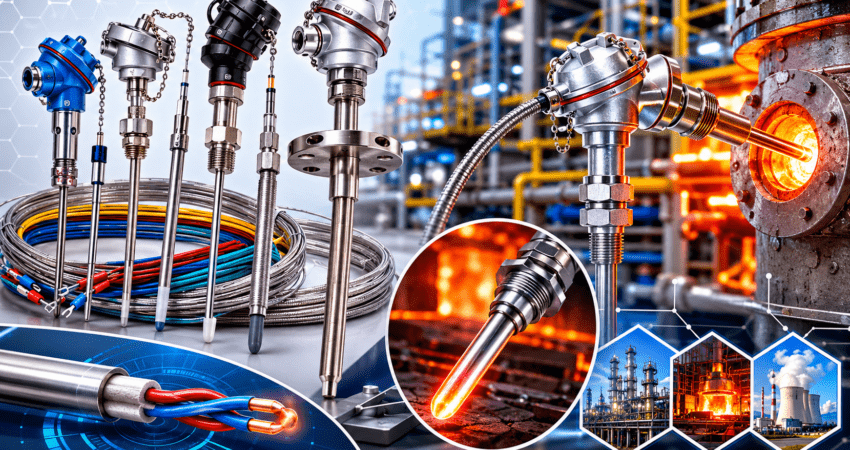
Temperature measurement plays a critical role in modern industrial processes. From furnaces and boilers to chemical reactors and food processing plants, accurate temperature monitoring ensures product quality, process efficiency, safety, and regulatory compliance.
Among the most widely used temperature sensors in industrial applications are thermocouples. Their rugged construction, wide temperature range, fast response time, and cost-effectiveness make them a preferred choice across industries.
This comprehensive guide explains everything you need to know about thermocouples, including their working principle, types, applications, advantages, limitations, and selection criteria.
What is a Thermocouple?
A thermocouple is a temperature sensor made by joining two dissimilar metal wires together at one end. When the junction experiences a temperature change, a small voltage is generated. This voltage is proportional to the temperature difference and is used to determine the measured temperature.
Thermocouples are among the oldest and most reliable temperature measurement technologies used in industrial environments.
Key Features
- Wide temperature measurement range
- Fast response time
- Rugged construction
- Cost-effective solution
- Suitable for harsh environments
- Available in various metal combinations
Working Principle of Thermocouples
Thermocouples operate based on the Seebeck Effect.
The Seebeck Effect states that when two different metals are joined and subjected to different temperatures at their junctions, a voltage is generated.
Working Process
- Two dissimilar metals are joined at one end.
- The junction is exposed to the process temperature.
- The reference junction remains at a known temperature.
- A thermoelectric voltage is generated.
- The measuring instrument converts the voltage into temperature.
The generated voltage is very small, typically measured in millivolts (mV), requiring accurate signal conditioning and temperature transmitters.
Construction of a Thermocouple
A typical thermocouple assembly consists of:
- Measuring junction
- Thermocouple wires
- Mineral insulation
- Protective sheath
- Terminal head or connector
- Thermowell (optional)
For harsh industrial applications, thermocouples are often installed inside thermowells to protect them from pressure, corrosion, vibration, and mechanical damage.
Types of Thermocouples
Different thermocouple types are designed for specific temperature ranges and operating environments.
Type K Thermocouple
Material
- Chromel
- Alumel
Temperature Range
-200°C to 1260°C
Applications
- Furnaces
- Heat treatment plants
- Power generation
- Industrial heaters
Type K is the most commonly used thermocouple due to its versatility and affordability.
Type J Thermocouple
Material
- Iron
- Constantan
Temperature Range
-40°C to 750°C
Applications
- Plastics industry
- Manufacturing processes
- Industrial machinery
Type T Thermocouple
Material
- Copper
- Constantan
Temperature Range
-200°C to 350°C
Applications
- Food processing
- Cryogenic systems
- Laboratories
Type E Thermocouple
Material
- Chromel
- Constantan
Temperature Range
-200°C to 900°C
Applications
- Chemical plants
- Low-temperature measurements
Type N Thermocouple
Temperature Range
-200°C to 1300°C
Applications
- High-temperature industrial processes
- Power plants
Noble Metal Thermocouples
Type R
Platinum-Rhodium
Type S
Platinum-Rhodium
Type B
Platinum-Rhodium
Applications
- Glass manufacturing
- Aerospace
- Steel plants
- High-temperature furnaces
Thermocouple Temperature Ranges
| Thermocouple Type | Temperature Range |
|---|---|
| Type K | -200°C to 1260°C |
| Type J | -40°C to 750°C |
| Type T | -200°C to 350°C |
| Type E | -200°C to 900°C |
| Type N | -200°C to 1300°C |
| Type R | 0°C to 1600°C |
| Type S | 0°C to 1600°C |
| Type B | 600°C to 1800°C |
Advantages of Thermocouples
Thermocouples offer several benefits that make them ideal for industrial temperature measurement.
Wide Temperature Range
Capable of measuring temperatures from cryogenic levels to above 1800°C.
Fast Response
Provides rapid temperature detection and control.
Durable Construction
Suitable for demanding industrial environments.
Cost-Effective
Generally more economical than RTDs for high-temperature applications.
Self-Powered Sensor
No external power supply is required for sensing.
Compact Design
Easy installation in confined spaces.
Limitations of Thermocouples
While highly versatile, thermocouples also have some limitations.
- Lower accuracy than RTDs
- Susceptible to electrical noise
- Signal drift over time
- Requires cold junction compensation
- Periodic calibration recommended
Industrial Applications of Thermocouples
Thermocouples are widely used across numerous industries.
Steel Industry
- Heat treatment furnaces
- Reheating furnaces
- Annealing operations
Power Plants
- Boilers
- Turbines
- Flue gas monitoring
Chemical Industry
- Reactors
- Distillation columns
- Process vessels
Pharmaceutical Industry
- Sterilization systems
- Process monitoring
Food Processing
- Ovens
- Dryers
- Pasteurization systems
Glass Manufacturing
- Melting furnaces
- Annealing furnaces
Plastics Industry
- Extrusion machines
- Injection molding equipment
Aerospace Industry
- Engine testing
- High-temperature research
How to Select the Right Thermocouple
Selecting the correct thermocouple improves process reliability and measurement accuracy.
Consider the following factors:
Temperature Range
Choose a thermocouple suitable for the operating temperature.
Process Environment
Evaluate:
- Corrosion
- Oxidation
- Moisture
- Chemical exposure
Accuracy Requirements
Determine acceptable measurement tolerances.
Response Time
Critical for fast-changing processes.
Installation Requirements
Consider:
- Probe length
- Diameter
- Mounting arrangement
- Thermowell compatibility
Budget
Balance performance and cost requirements.
Thermocouple vs RTD
| Feature | Thermocouple | RTD |
| Temperature Range | Very Wide | Moderate |
| Accuracy | Moderate | High |
| Response Time | Fast | Moderate |
| Durability | Excellent | Good |
| Cost | Lower | Higher |
| High Temperature Capability | Excellent | Limited |
Thermocouples are generally preferred for high-temperature industrial applications, while RTDs are selected when higher accuracy is required.
Common Thermocouple Problems and Troubleshooting
Incorrect Temperature Reading
Possible Causes:
- Wrong thermocouple type setting
- Calibration issues
- Wiring errors
Signal Fluctuation
Possible Causes:
- Electrical interference
- Loose connections
- Damaged extension cables
Sensor Failure
Possible Causes:
- Excessive temperature exposure
- Mechanical damage
- Corrosion
Drift in Measurement
Possible Causes:
- Aging sensor
- Contamination
- Thermal cycling
Regular inspection and calibration can significantly improve reliability.
Why Choose Yog Electro Process Pvt. Ltd.
Yog Electro Process Pvt. Ltd. (YEPPL) is a trusted Indian manufacturer and supplier of industrial temperature measurement solutions.
What Sets YEPPL Apart?
- High-quality thermocouples for diverse industries
- Custom-built sensor assemblies
- Application-specific designs
- ZED Silver Certified Manufacturing Facility
- NABL Calibration Facilities for accurate measurement verification
- Comprehensive range of thermowells and accessories
- Technical support and engineering expertise
- Reliable nationwide service
In addition to thermocouples, YEPPL offers RTD sensors, temperature transmitters, temperature controllers, industrial heaters, thermowells, and thermal insulation products for complete temperature management solutions.
Frequently Asked Questions
What is the main purpose of a thermocouple?
A thermocouple is used to measure temperature by generating a voltage corresponding to the temperature difference between two dissimilar metals.
Which thermocouple is most commonly used?
Type K thermocouple is the most widely used due to its broad temperature range and affordability.
What is the maximum temperature a thermocouple can measure?
Type B thermocouples can measure temperatures up to approximately 1800°C.
Are thermocouples accurate?
Thermocouples provide good industrial accuracy, although RTDs generally offer higher precision.
How long do thermocouples last?
Service life depends on operating conditions, temperature, and environmental exposure. Proper installation and protection can significantly extend lifespan.
Conclusion
Thermocouples remain one of the most versatile and widely used temperature sensors in industrial applications. Their ability to withstand harsh conditions, measure extremely high temperatures, and provide rapid response makes them indispensable in manufacturing, power generation, chemical processing, heat treatment, and many other industries.
Selecting the appropriate thermocouple type, sheath material, and installation method ensures accurate and reliable temperature measurement. Partnering with an experienced manufacturer like Yog Electro Process Pvt. Ltd. helps organizations achieve improved process control, operational efficiency, and long-term reliability.